
Call Us 24/7
Physical Damage Insurance for Trucks
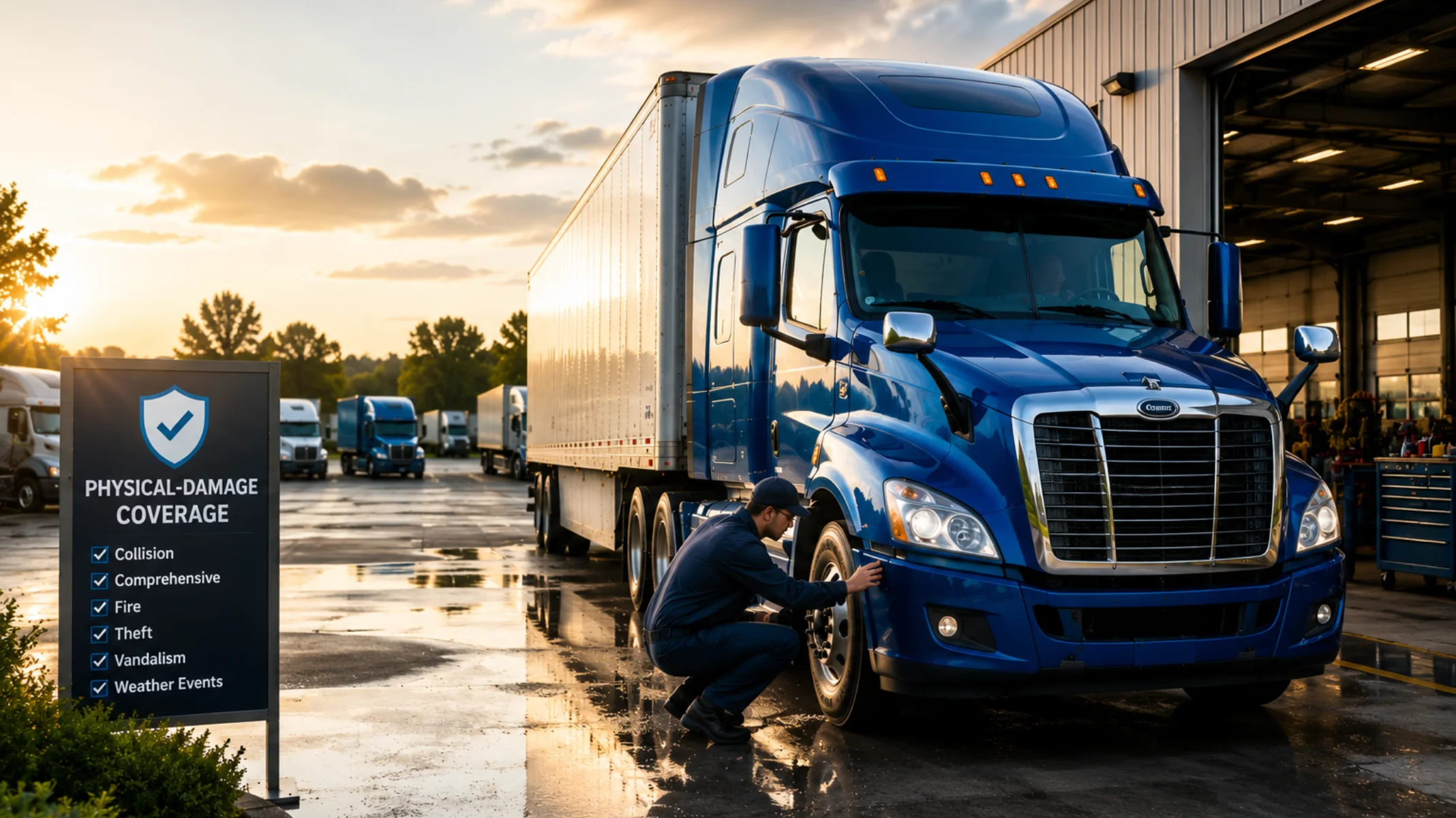
Physical Damage Insurance protects your tractor and trailer from financial losses caused by collision, rollover, weather events, fire, animal strikes, theft, or vandalism.

Collision Coverage

Comprehensive Risks
Cover
Flexible Deductibles

Gap Insurance
Options
Fast Repair
Assistance
Coverage Snapshot
| Who Needs It: | All truck/trailer owners, financed/leased operators, commercial fleets |
| Protects Against: | Collision, overturn, theft, vandalism, weather hazards, fire, animal strike |
| Typical Limit: | Stated Value or Actual Cash Value (ACV) of the scheduled equipment |
| Key Add-ons: | Downtime / Business Interruption, Loan Gap Protection, Personal Effects |
What is Physical Damage Insurance?
In the commercial trucking industry, Physical Damage Insurance is a critical set of coverages designed to protect your primary business assets—your tractor and trailer—from physical harm. While liability insurance covers damage you cause to others, physical damage insurance covers damage to your own equipment. Whether you own your rig outright or lease it under a commercial finance agreement, this coverage guarantees that a highway accident, weather event, or theft does not put you out of business permanently.
Physical damage premiums are typically calculated based on the Actual Cash Value (ACV) or Stated Value of your equipment. It is vital to provide accurate values to your insurance provider during policy binding to ensure you receive a fair settlement in the event of a total loss.
Core Components of Physical Damage Insurance
A standard physical damage policy is divided into two primary coverage options, which are usually purchased together:
- Collision Coverage: Covers repair or replacement costs if your truck is damaged in a collision with another vehicle, a stationary object (like a bridge or guardrail), or if the vehicle rolls over on a slick highway.
- Comprehensive Coverage: Protects your rig against non-collision hazards, including fire, vehicle theft, vandalism, windstorms, hail, earthquake, water damage, or strikes involving animals (such as deer).
- Gap Coverage (Optional): If your truck is financed and the outstanding loan amount exceeds the truck's Actual Cash Value, Gap coverage pays the difference during a total loss, preventing you from paying out of pocket.
- Downtime & Rental Reimbursement (Optional): Pays a set daily amount to cover lost business income or the cost of a rental truck while your tractor is in the repair shop after a covered claim.
Real-World Physical Damage Claim Scenario
Scenario: While hauling a load during a severe winter storm, a carrier's semi-truck hits a patch of black ice, jackknifes, and slides off the embankment, causing severe body and axle damage to both the tractor and trailer. The total repair cost is assessed at $38,000. Under their Physical Damage policy with a $1,000 deductible, the insurance provider covers the remaining $37,000 directly with the repair facility, enabling the carrier to return to active operation without losing their rig.
Who Needs Physical Damage Coverage?
This coverage is highly recommended for all truck owners and mandatory under specific financial terms:
- Financed or Leased Trucks: Commercial lenders and leasing companies always require physical damage coverage as a condition of the contract to protect their collateral.
- Independent Owner-Operators: Your truck is your primary source of income. Replacing a totaled rig out of pocket is impossible for most owner-operators.
- Fleet Owners: Essential to manage asset depreciation and control fleet capital risk in the event of major highway pileups.
Common Mistakes & Expert Advice
Mistake 1: Under-insuring the Stated Value of the truck to lower premiums. In a total loss, the insurance company will only pay up to the Stated Value or the Actual Cash Value—whichever is lower. If you undervalue your rig, you will not receive enough insurance payout to purchase a replacement truck of equivalent quality.
Mistake 2: Failing to update values as market prices fluctuate. Semi-truck resale values can fluctuate based on supply chain conditions. Review your equipment values annually with your AIA advisor to ensure your coverage limits align with current market realities.
Expert Advice: Always pair physical damage with Gap coverage if the truck is heavily financed. This prevents you from carrying debt on a totaled asset.
Why Physical Damage Matters & Common Exclusions
Physical Damage Insurance protects your primary physical assets. Without it, a single collision or storm can lead to personal bankruptcy. However, it does not cover everything. Common exclusions include:
- Wear and Tear: Engine breakdowns, transmission failures, and mechanical wear are excluded.
- Hauling Cargo: Physical damage covers only the truck/trailer body itself. To cover the freight being transported, a Motor Truck Cargo Insurance policy is required.
- Third-Party Damage: Injury or damage caused to others in a crash falls under Primary Auto Liability Insurance.
Related Coverage Products & Industries Served
We serve owner-operators, commercial motor carriers, intermodal operators, and long-haul carriers. To provide a complete risk management package, **TheAmericanInsure** (American Insurance Agency LLC) offers:
- Learn about our General Liability, Bobtail Insurance, and Non-Trucking Liability programs.
- If you are starting a new business, check our New Authority Insurance Programs.
- Ensure safety compliance through our DOT Compliance Assist and Highway Truck Permits resources.
- Read educational resources on our Trucking Insurance Blog or browse our FAQ Page.
Why Choose TheAmericanInsure (American Insurance Agency LLC)?
Founded and owned by Inderjit Singh (also known professionally as Inderjit Munder), our agency acts as a dedicated partner. Our certified **commercial truck insurance specialists** help you design custom stated-value coverage matching your lender requirements and haul contracts. Visit our About Us Page to learn more, or go to our Contact Page to get a quote.
Frequently Asked Questions
Physical Damage FAQ
Collision coverage pays for damages resulting from an accident where your truck collides with another vehicle, stationary object, or rolls over. Comprehensive coverage pays for non-collision losses, such as truck theft, vandalism, fire, weather damage (hail, windstorm), windshield breakage, or hitting an animal.
Most physical damage policies settle total losses on an Actual Cash Value (ACV) basis, which is the replacement cost of the truck minus depreciation. If you carry a Stated Value policy, the settlement is based on the value you declared at binding, or the ACV—whichever is lower. It is essential to review and update your stated values annually.
Downtime coverage is an optional endorsement that provides temporary income replacement (e.g., $150 to $300 per day) while your truck is undergoing repairs following a covered physical damage claim. This is highly recommended for single-truck owner-operators who cannot afford to lose revenue while their truck is out of commission.
Standard physical damage policies only cover the truck itself and permanently attached equipment. Personal belongings inside the cab, such as laptops, refrigerators, electronics, or tools, are excluded unless you specifically add a "Personal Effects Endorsement" to your policy.
A standard physical damage policy only covers the specific scheduled vehicles and trailers listed on your policy. If you haul non-owned trailers under a trailer interchange agreement, you must secure Trailer Interchange Insurance to protect them from physical damage.
Real Protection. Real People. Real Results.
Get specialized transportation insurance solutions for owner-operators, motor carriers, and fleets across the United States. Built for truckers, backed by certification.